
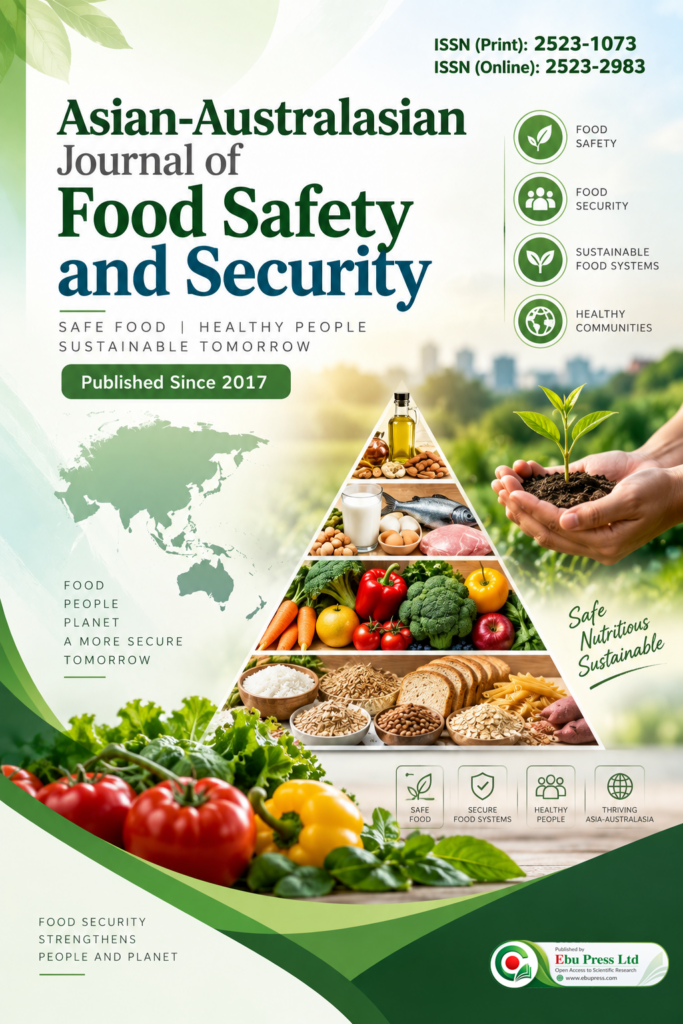
Genesis Research Consultancy Limited (GRCL) provided specialized COPE Inclusion Consultancy to the Asian-Australasian Journal of Food Safety and Security, supporting the journal in strengthening its publication ethics framework, editorial policies, research-integrity practices, and overall scholarly publishing infrastructure.
The consultancy was focused on helping the journal establish a more transparent, systematic, and professionally documented framework for responsible academic publishing, with particular attention to principles associated with the Committee on Publication Ethics (COPE) and internationally recognized standards of scholarly journal management.
Project Overview
The Asian-Australasian Journal of Food Safety and Security serves the scientific community working across food safety, food security, food science, nutrition, agricultural systems, microbiology, public health, food technology, and related disciplines. For a scientific journal operating in these fields, maintaining robust publication-ethics procedures is particularly important. Research published in food-safety and food-security journals can influence scientific knowledge, public-health policy, agricultural practices, food production, and consumer safety.
GRCL was engaged to provide consultancy focused on COPE inclusion readiness and publication ethics development, helping the journal strengthen its policies and procedures for responsible scholarly communication. The project brought together several interconnected areas of journal management:
Publication Ethics → Research Integrity → Editorial Governance → Peer Review → Author Responsibilities → Reviewer Responsibilities → Post-Publication Management → Publishing Transparency
Objectives of the Consultancy
The primary objective of the consultancy was to support the journal’s development of a comprehensive and transparent publication-ethics framework. Key objectives included:
- Reviewing the journal’s publication-ethics framework
- Strengthening editorial policies
- Improving transparency of publishing procedures
- Supporting COPE-oriented journal development
- Clarifying responsibilities of authors, editors, reviewers, and publishers
- Strengthening research-integrity procedures
- Developing approaches for handling publication misconduct
- Improving policies concerning authorship and contributorship
- Strengthening conflict-of-interest disclosure procedures
- Establishing clearer correction and retraction mechanisms
- Supporting transparent complaint and appeal procedures
- Strengthening ethical oversight requirements
- Promoting responsible peer-review practices
COPE Inclusion Consultancy
The Committee on Publication Ethics (COPE) provides widely recognized resources and principles concerning publication ethics and responsible scholarly publishing. GRCL’s consultancy therefore focused on helping the journal understand and address important publication-ethics considerations relevant to a professionally managed scientific journal. The consultancy considered areas including:
- Publication ethics
- Editorial responsibility
- Peer-review ethics
- Research misconduct
- Plagiarism
- Duplicate and redundant publication
- Authorship
- Contributorship
- Conflicts of interest
- Corrections
- Retractions
- Expressions of concern
- Complaints
- Appeals
- Ethical oversight
- Editorial independence
- Publishing transparency
The goal was to develop a coherent publication-ethics system, rather than treating each policy as an independent document.
Publication Ethics Framework
A strong publication-ethics framework establishes expectations for everyone involved in scholarly communication. GRCL supported the journal in strengthening its approach to responsible publishing by addressing the roles and responsibilities of:
Authors
Authors should be responsible for the integrity, originality, accuracy, and ethical conduct of their submitted research.
Editors
Editors should make publication decisions based on scholarly considerations while maintaining appropriate confidentiality, fairness, and editorial independence.
Reviewers
Reviewers should provide objective, confidential, constructive, and ethically responsible evaluations.
Publisher or Journal Management
The publishing organization should provide appropriate infrastructure and support for ethical journal operations.
Editorial Board
Editorial board members should contribute to the journal’s scholarly quality and ethical governance while following clearly defined responsibilities.
Editorial Policy Consultancy
Editorial policies are fundamental to the operation and credibility of an academic journal. GRCL provided consultancy concerning the structure and clarity of editorial policies covering areas such as:
- Manuscript submission
- Initial editorial assessment
- Peer review
- Editorial decision-making
- Revision procedures
- Acceptance and rejection
- Publication ethics
- Research integrity
- Author responsibilities
- Reviewer responsibilities
- Editorial responsibilities
- Conflicts of interest
- Complaints and appeals
The objective was to help establish a publishing workflow that is transparent, consistent, understandable, and ethically defensible.
Peer-Review Ethics
Peer review is a critical quality-control mechanism in scientific publishing. The consultancy addressed principles for maintaining ethical peer review, including:
- Reviewer confidentiality
- Objective evaluation
- Constructive reviewer comments
- Declaration of competing interests
- Avoidance of inappropriate use of unpublished information
- Appropriate reviewer selection
- Editorial oversight
- Consistency in peer-review procedures
For a multidisciplinary journal covering food safety and security, ethical peer review is especially important because published findings may have implications extending beyond academia.
Authorship & Contributorship Policy
Authorship disputes can create significant ethical and editorial challenges. GRCL supported the journal in strengthening its approach to:
- Authorship eligibility
- Author contributions
- Corresponding-author responsibilities
- Changes in authorship
- Addition or removal of authors
- Authorship disputes
- Acknowledgment of non-author contributions
- Contributor transparency
A clear authorship policy can help establish expectations before manuscript submission and provide a framework for addressing disputes when they arise.
Conflict of Interest Consultancy
Transparency concerning potential conflicts of interest is an important element of research and publication integrity. GRCL’s consultancy addressed disclosure and management of potential conflicts involving:
- Authors
- Reviewers
- Editors
- Editorial board members
- Other stakeholders involved in publication decisions
Potential conflicts may involve financial, professional, institutional, personal, or other interests capable of affecting—or appearing to affect—research or editorial judgment. Clear disclosure procedures help readers and editors evaluate the research and publication process with greater transparency.
Plagiarism & Publication Misconduct
Research integrity requires appropriate procedures for identifying and responding to publication misconduct. GRCL provided consultancy concerning journal policies related to:
- Plagiarism
- Self-plagiarism
- Duplicate publication
- Redundant publication
- Fabrication
- Falsification
- Data manipulation
- Image manipulation
- Citation manipulation
- Undisclosed conflicts of interest
- Other forms of publication misconduct
The consultancy emphasized that automated similarity screening should be treated as a screening tool rather than an automatic determination of misconduct. Contextual editorial assessment remains essential.
Research Integrity
Scientific journals have a responsibility to protect the reliability of the published scholarly record. GRCL’s publication-ethics consultancy therefore addressed broader research-integrity principles, including:
- Accuracy of scientific reporting
- Responsible data presentation
- Ethical research conduct
- Transparent methodology
- Appropriate citation
- Research misconduct procedures
- Ethical oversight
- Post-publication correction mechanisms
For food-safety and food-security research, research integrity is particularly significant because inaccurate or misleading findings can potentially influence public-health and food-system decisions.
Ethical Oversight
Food-safety research can involve human participants, animals, biological materials, laboratory organisms, field studies, surveys, and other research contexts requiring ethical consideration. GRCL supported the journal’s approach to appropriate ethical oversight, including policies concerning:
- Ethics committee approval
- Institutional review
- Informed consent where applicable
- Animal research ethics
- Human participant research
- Relevant regulatory requirements
- Ethical declarations in manuscripts
The objective was to ensure that authors are clearly informed about their ethical responsibilities before submitting research for publication.
Corrections & Retractions
Maintaining the integrity of the published scholarly record does not end when an article is published. GRCL provided consultancy concerning appropriate mechanisms for addressing significant problems discovered after publication. These mechanisms may include:
- Corrections
- Errata
- Retractions
- Expressions of concern
- Editorial notices
- Post-publication amendments
A transparent post-publication policy allows a journal to respond appropriately when errors or integrity concerns affect published research.
Complaints & Appeals
A professionally managed academic journal should provide mechanisms for authors and other stakeholders to raise legitimate concerns. GRCL’s consultancy considered transparent procedures for:
- Editorial complaints
- Appeals against editorial decisions
- Peer-review concerns
- Publication-related disputes
- Ethical complaints
- Allegations of misconduct
- Concerns regarding editorial processes
Clear procedures can help journals manage disputes consistently while maintaining fairness and editorial independence.
Editorial Independence
Editorial independence is an important component of credible scholarly publishing. GRCL’s consultancy addressed the importance of establishing clear boundaries between editorial decision-making and external pressures. Editorial decisions should be guided primarily by:
- Scientific quality
- Relevance
- Methodological rigor
- Ethical compliance
- Scholarly contribution
- Journal scope
Clear governance arrangements help strengthen trust among authors, reviewers, editors, readers, and the broader academic community.
Publishing Transparency
Transparency is a major component of responsible journal management. GRCL supported the journal’s efforts to clearly communicate relevant information concerning:
- Journal ownership
- Publisher information
- Editorial leadership
- Editorial board
- Peer-review process
- Publication ethics
- Authorship
- Conflicts of interest
- Copyright
- Open-access arrangements
- Publication charges, where applicable
- Complaints and appeals
- Corrections and retractions
Transparent journal information helps researchers make informed decisions when selecting journals for scholarly communication.
Food Safety & Research Integrity
The subject area of food safety makes ethical and scientifically rigorous publishing particularly important. Food-safety research may address:
- Foodborne pathogens
- Microbial contamination
- Food hygiene
- Food quality
- Food toxicology
- Food chemistry
- Antimicrobial resistance
- Food processing
- Food preservation
- Food contaminants
- Risk assessment
- Public health
- Food production systems
Research findings in these areas can potentially affect consumers, food producers, regulators, healthcare professionals, and policymakers. Consequently, maintaining a strong publication-ethics framework is essential for ensuring that scientific evidence is communicated responsibly.
Food Security & Scholarly Publishing
Food security research is similarly multidisciplinary and can involve:
- Agricultural production
- Food availability
- Food access
- Nutrition
- Livelihoods
- Sustainable agriculture
- Climate resilience
- Food systems
- Rural development
- Agricultural economics
- Food policy
The journal’s publication-ethics framework therefore needs to accommodate research spanning multiple scientific and applied disciplines.
GRCL’s consultancy supported the development of a publishing framework appropriate for a multidisciplinary journal working at the intersection of food, agriculture, health, biotechnology, environment, and public policy.
GRCL’s Consultancy Methodology
GRCL approached the project through a structured journal-development framework.
1. Existing Framework Assessment
The journal’s existing policies, procedures, and editorial information were considered from a publication-ethics perspective.
2. Gap Identification
Potential areas requiring clarification, expansion, or improved documentation were identified.
3. Policy Structuring
Relevant ethical and editorial policies were organized into a coherent journal-wide framework.
4. COPE-Oriented Development
The journal’s policies were considered in relation to recognized principles of responsible scholarly publishing associated with COPE.
5. Transparency Enhancement
Recommendations focused on improving clarity and accessibility of important journal information.
6. Editorial Governance
Attention was given to responsibilities and procedures affecting editors, reviewers, authors, and journal management.
Key Consultancy Areas
The project incorporated a broad range of publication-ethics and journal-development topics:
| Consultancy Area | Focus |
|---|---|
| COPE Inclusion | COPE-oriented journal readiness |
| Publication Ethics | Responsible scholarly publishing |
| Editorial Policy | Transparent editorial procedures |
| Peer Review | Ethical and confidential review |
| Authorship | Authorship and contributorship |
| Conflicts of Interest | Disclosure and management |
| Research Integrity | Responsible research and reporting |
| Plagiarism | Detection and appropriate assessment |
| Misconduct | Handling ethical concerns |
| Corrections | Maintaining accurate publications |
| Retractions | Protecting the scholarly record |
| Complaints | Transparent complaint procedures |
| Appeals | Fair editorial appeal mechanisms |
| Ethical Oversight | Research ethics requirements |
| Editorial Independence | Responsible editorial governance |
| Transparency | Clear journal information |
Project Outcomes
The consultancy supported the Asian-Australasian Journal of Food Safety and Security in strengthening several important dimensions of journal management.
Stronger Publication Ethics
The journal was supported in developing a more structured approach to publication ethics.
Improved Editorial Governance
Editorial roles and responsibilities were considered within a clearer governance framework.
Enhanced Research Integrity
The consultancy addressed mechanisms for dealing with plagiarism, misconduct, conflicts, and other integrity concerns.
More Transparent Peer Review
The journal was supported in clarifying principles governing responsible peer review.
Better Post-Publication Management
Policies concerning corrections, retractions, and post-publication concerns were incorporated into the ethical framework.
Stronger Scholarly Publishing Infrastructure
The consultancy contributed to the journal’s broader development toward transparent and professionally managed scholarly publishing.
GRCL’s Role
For this project, Genesis Research Consultancy Limited (GRCL) served as a specialized publication ethics and COPE inclusion consultancy provider. GRCL’s role included consultancy and strategic guidance concerning:
- COPE-oriented journal readiness
- Publication ethics
- Editorial governance
- Peer-review ethics
- Research integrity
- Authorship policies
- Conflict-of-interest policies
- Plagiarism and misconduct
- Ethical oversight
- Corrections and retractions
- Complaints and appeals
- Publishing transparency
The consultancy was designed to strengthen the journal’s internal publishing framework and support its continued development as a responsible scholarly publication.
Why Choose GRCL for Journal Publication Ethics Consultancy?
GRCL combines expertise in research methodology, scientific writing, academic publishing, statistical analysis, journal development, and publication ethics. This multidisciplinary experience enables GRCL to approach journal consultancy from both the research and publishing perspectives. Our consultancy can help academic journals address:
- Publication ethics
- Editorial policies
- Research integrity
- Peer-review systems
- Journal governance
- Scholarly communication
- Publishing transparency
- Journal development
- Indexing-readiness preparation
GRCL focuses on practical, transparent, evidence-informed consultancy rather than making unrealistic guarantees about external membership, indexing, or evaluation decisions.
About Genesis Research Consultancy Limited (GRCL)
Genesis Research Consultancy Limited (GRCL) is a research and scholarly publishing consultancy organization established in 2015. GRCL provides professional consultancy and research support across scientific and academic disciplines.
Core Services
- Research consultancy
- Scientific writing
- Manuscript development
- Manuscript editing
- Statistical analysis
- Research methodology
- Thesis and dissertation support
- Literature review
- Systematic review support
- Data analysis
- Data visualization
- GIS and research mapping
- Journal development
- Publication ethics consultancy
- COPE inclusion consultancy
- Editorial policy development
- Scholarly publishing consultancy
- Journal indexing-readiness consultancy
GRCL works with researchers, academics, universities, journals, publishers, research organizations, and other institutions involved in scholarly communication.
Project Information
Project Title: COPE Inclusion Consultancy for Asian-Australasian Journal of Food Safety and Security
Client: Asian-Australasian Journal of Food Safety and Security
Consultancy Provider: Genesis Research Consultancy Limited (GRCL)
Service: COPE Inclusion & Publication Ethics Consultancy
Industry: Academic Publishing & Scholarly Communication
Research Area: Food Safety, Food Security, Food Science, Agriculture, Biotechnology & Public Health
Consultancy Focus: Publication Ethics, Research Integrity, Editorial Governance, Peer Review & Journal Development
The COPE Inclusion Consultancy for the Asian-Australasian Journal of Food Safety and Security demonstrates GRCL’s commitment to strengthening ethical, transparent, and professionally managed scholarly publishing.
Through an integrated approach to publication ethics, research integrity, editorial governance, peer review, authorship, conflicts of interest, ethical oversight, corrections, retractions, complaints, appeals, and publishing transparency, GRCL supported the journal’s efforts to build a stronger publication framework.
For journals seeking to strengthen their publication ethics infrastructure, improve editorial transparency, and prepare for engagement with internationally recognized scholarly publishing standards, Genesis Research Consultancy Limited (GRCL) provides structured and research-informed consultancy services.
Genesis Research Consultancy Limited (GRCL)
Research Consultancy | Scientific Writing | Statistical Analysis | Journal Development | Publication Ethics | COPE Consultancy | Scholarly Publishing
Website: https://genrescon.com/
Contact us today for your journal indexing support.
Research. Integrity. Publishing Excellence.