
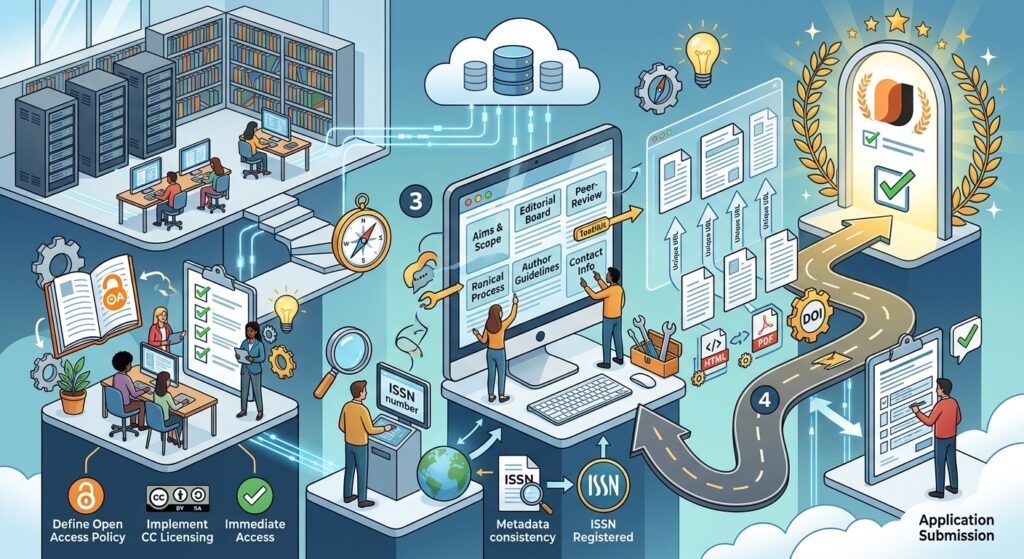
DOAJ, or the Directory of Open Access Journals, is a major global directory of quality, peer-reviewed, open-access scholarly journals. DOAJ’s purpose is not simply to provide a list of journals. Its inclusion process evaluates whether journals meet defined standards relating to open access, transparency, editorial practices, peer review, licensing, journal information, and publishing quality.
DOAJ explains that its metadata is reused by discovery services, search engines, academic libraries, research platforms, and other scholarly information systems. For this reason, inclusion in DOAJ can contribute to:
- Improved journal discoverability
- Greater international visibility
- Better metadata dissemination
- Increased confidence among authors and readers
- Improved transparency in scholarly publishing
- Greater visibility through library and discovery systems
- Stronger positioning as an open-access scholarly journal
- Alignment with recognized open-access publishing practices
Importantly, DOAJ indexing is not the same as Scopus or Web of Science indexing. Each database has its own criteria, review process, scope, and policies. This blog post describes how to get a Journal Indexed in DOAJ and outlines how Genesis Research Consultancy Limited (GRCL) can guide journals and publishers through every step of the process.
Why Should a Journal Apply for DOAJ Indexing?
For a legitimate open-access scholarly journal, DOAJ inclusion can provide substantial visibility and credibility benefits. DOAJ states that its metadata is used by numerous discovery services, search engines, library systems, research organizations, and other platforms.
1. Increased Discoverability
A journal included in DOAJ becomes discoverable through DOAJ’s own platform and through services that reuse DOAJ metadata. This can help researchers discover:
- The journal
- Journal articles
- Article metadata
- Authors
- Subject areas
- Open-access information
2. Stronger Open-Access Visibility
DOAJ is specifically focused on open-access scholarly journals. Being accepted therefore demonstrates that the journal has passed an editorial assessment against DOAJ’s inclusion requirements.
3. Improved Publishing Transparency
Preparing for DOAJ often requires a publisher to make important information clearly available, including:
- Aims and scope
- Editorial board
- Peer-review process
- Copyright policy
- Licensing policy
- Open-access policy
- Author guidelines
- Publication charges
- Contact information
- Editorial processes
This transparency can improve the overall quality of the journal website.
4. Better Metadata Distribution
DOAJ explains that its metadata is freely reusable and can be incorporated into numerous discovery systems. Therefore, DOAJ inclusion should be viewed not merely as a badge but as part of a broader scholarly discoverability strategy.
Can Every Journal Apply for DOAJ?
No. A journal should first determine whether it satisfies DOAJ’s basic inclusion criteria. DOAJ states that open-access journals published in any language may apply, but the journal must be actively publishing scholarly research and should publish at least five research articles per year. Its primary target audience should be researchers or practitioners. A publisher should therefore conduct a DOAJ readiness assessment before submitting an application.
How to Get a Journal Indexed in DOAJ
Step 1: Confirm That the Journal Is a Genuine Open-Access Journal
The first and most important question is:
Is the journal genuinely open access according to DOAJ’s definition?
A journal should provide immediate and free access to its scholarly content. DOAJ’s guidance indicates that full text should be freely accessible without an embargo and without requiring users to register merely to read the content. The journal should also use an appropriate open license.
A DOAJ-ready journal should clearly explain:
- What open access means for the journal
- Whether articles are immediately accessible
- What license applies to published articles
- Who owns copyright
- What readers are permitted to do with published content
For many journals, a clearly stated Creative Commons licensing policy is an important part of this structure.
Step 2: Ensure That the Journal Has a Valid ISSN
A journal applying to DOAJ needs appropriate ISSN information. The journal title, ISSN information, and website information should be consistent. DOAJ’s application documentation states that the ISSN must be valid, fully registered and confirmed at the ISSN Portal, and that the ISSN should match the information displayed on the journal website.
GRCL ISSN consultancy can help with:
- ISSN readiness assessment
- Online ISSN/e-ISSN preparation
- Print ISSN/p-ISSN considerations
- ISSN information consistency
- Journal title consistency
- Website ISSN display
- ISSN metadata review
Publishers should not treat an ISSN as evidence that a journal has been indexed. ISSN identifies a serial publication; DOAJ inclusion is a separate editorial evaluation.
Step 3: Build a Professional Journal Website
A journal website is one of the most important components of DOAJ readiness. The website should not merely look attractive. It should provide the information that authors, reviewers, editors, readers, librarians, and indexing services need. DOAJ’s criteria emphasize a dedicated journal website, clear navigation, accessible information, and individual article pages.
A professional journal website should contain:
- Journal title
- ISSN/e-ISSN
- Publisher information
- Aims and scope
- Editorial board
- Editorial office information
- Author guidelines
- Peer-review policy
- Publication ethics
- Open-access policy
- Copyright policy
- Licensing policy
- APC/publication fee information
- Waiver policy, if applicable
- Contact information
- Archiving/preservation information
- Individual article pages
- Article abstracts
- Full-text files
- Publication dates
- DOI information, where applicable
Step 4: Make Every Article Individually Accessible
One of the most important technical requirements is that articles should be individually accessible. A journal should not place all articles inside one large PDF or make it difficult for readers to identify individual publications. DOAJ’s published criteria indicate that each article should be available as an individual full-text article with a unique URL, with HTML or PDF available at minimum.
Recommended article structure
Each article page should clearly show:
- Article title
- Author names
- Author affiliations
- Abstract
- Keywords
- Publication date
- DOI, if assigned
- Citation information
- Full-text access
- Licensing information
- Copyright information
- References
- Article type
This structure is also beneficial for search-engine visibility and scholarly metadata.
Step 5: Establish a Clear Aims and Scope
A journal should have a clearly written Aims and Scope page. The page should explain:
- Subject areas covered
- Types of research accepted
- Target readership
- Geographic or disciplinary focus, if applicable
- Article types accepted
- Topics outside the journal’s scope
Avoid extremely broad statements such as:
“This journal publishes research in all fields.”
A strong journal scope should be specific enough to demonstrate a genuine scholarly identity.
Step 6: Establish a Qualified Editorial Board
A functioning editorial board is essential to credible scholarly publishing. The journal should identify:
- Editor-in-Chief
- Associate Editors
- Section Editors, where applicable
- Editorial Board Members
- Institutional affiliations
- Countries or institutional locations, where appropriate
DOAJ’s application materials emphasize the importance of an editor and editorial board and the availability of their information on the journal website.
Editorial board information should be:
- Accurate
- Current
- Verifiable
- Professionally presented
- Consistent with the application
Publishers should obtain consent from scholars before listing them on an editorial board.
Step 7: Establish a Transparent Peer-Review System
A journal applying to DOAJ must clearly explain how manuscripts are evaluated. The website should contain a Peer Review Policy or Editorial Process page. It should explain:
- How manuscripts are initially screened
- Who performs editorial assessment
- Whether manuscripts are sent to external reviewers
- What type of peer review is used
- How reviewers are selected
- How conflicts of interest are handled
- How editorial decisions are made
- How revisions are managed
- How appeals or complaints are handled
The journal should describe its actual process—not an ideal process that it does not follow. DOAJ’s application documentation specifically asks about peer-review practices.
Step 8: Publish a Clear Open-Access Policy
The journal should have a dedicated Open Access Policy. The policy should explain:
- Whether articles are immediately open access
- Whether readers pay to access articles
- Whether registration is required
- What license applies
- Whether there is an embargo
- How authors retain or transfer copyright
- What readers are allowed to do with the content
The information should be easy to locate from the journal website.
Step 9: Publish a Clear Copyright Policy
Copyright information should not be hidden. The journal should clearly state:
- Who owns copyright
- Whether authors retain copyright
- What rights are granted to the publisher
- What rights readers receive
- How published material may be reused
The copyright policy must correspond to the journal’s actual publishing agreement.
Step 10: Establish an Appropriate Licensing Policy
Open-access journals should make their licensing terms clear. Many scholarly journals use Creative Commons licenses. The exact license should be stated consistently:
- On the journal website
- On article pages
- In published PDFs
- In article metadata
- In author agreements, where applicable
Inconsistency between these locations can create confusion during journal evaluation.
Step 11: Clearly Display All Author Charges
One common problem for journals is inadequate disclosure of publication fees. If the journal charges authors, the website should clearly explain the charges. Possible charges include:
- Submission fee
- Editorial processing fee
- Article processing charge (APC)
- Publication fee
- Page charge
- Colour charge
- Language-editing charge, if mandatory
- Other mandatory publication charges
If the journal has no author charges, say so clearly. DOAJ’s published criteria specifically require transparent information about author charges.
Example structure
Article Processing Charge: None
or
Article Processing Charge: USD XXX per accepted article. If waivers are available, explain:
- Eligibility
- Application procedure
- Geographic criteria, if applicable
- Whether the waiver is automatic or discretionary
Step 12: Establish a Publication Ethics Policy
A credible journal should maintain a detailed publication ethics framework. The website should address issues such as:
- Plagiarism
- Duplicate publication
- Fabrication
- Falsification
- Authorship disputes
- Conflicts of interest
- Peer-review confidentiality
- Research misconduct
- Corrections
- Retractions
- Complaints
- Appeals
- Editorial conflicts
The policy should reflect actual editorial procedures. A publisher should avoid copying generic ethics policies from another journal without adapting them to its own publishing structure.
Step 13: Follow Transparency and Best Practices
DOAJ expects journals to follow recognized principles of transparency and best practice in scholarly publishing. DOAJ provides a dedicated transparency and best-practice framework for journals. This means the journal should be transparent about:
- Ownership
- Editorial governance
- Publishing practices
- Peer review
- Fees
- Licensing
- Copyright
- Contact details
- Journal identity
- Archiving
- Complaints
- Ethical practices
Step 14: Maintain Real and Professional Contact Information
The journal should provide genuine contact information. The information should include:
- Publisher name
- Editorial office
- Contact person’s real name
- Dedicated journal email
- Publisher address
- Relevant institutional information
DOAJ’s criteria specifically address contact information and require clear journal contact details. Avoid relying exclusively on:
- Free generic email accounts
- Anonymous contact forms
- Social media accounts
- Messaging applications
A professional academic journal should have a traceable editorial identity.
Step 15: Ensure the Journal Is Actively Publishing
DOAJ expects journals to be actively publishing scholarly research. Its current guide says a journal should publish at least five research articles per year. Therefore, a publisher should maintain a realistic publication schedule. Examples include:
- Quarterly
- Biannual
- Continuous publication
- Annual publication
The declared publication frequency should correspond to actual publishing activity.
Step 16: Prepare the Journal’s Article Backlog
Before applying, review the journal’s published articles. Check whether each article has:
- Unique URL
- Title
- Author information
- Abstract
- Keywords
- Publication date
- Full text
- License
- Copyright information
- References
- DOI, where applicable
- Correct metadata
This is especially important for journals hosted on platforms such as OJS.
Step 17: Review OJS Configuration
Many academic journals use Open Journal Systems (OJS). OJS can provide a useful technical foundation for journal publishing, but installing OJS alone does not make a journal DOAJ-ready. The publisher should configure:
- Journal title
- ISSN
- Publisher information
- Journal description
- Editorial team
- Submission workflow
- Peer review
- Author guidelines
- Publication policies
- Copyright
- Licensing
- Open-access information
- Article metadata
- DOI integration, if applicable
- Search-engine metadata
- Article landing pages
GRCL can provide OJS journal setup and publishing consultancy as part of a broader journal-development project.
Step 18: Check Metadata Consistency
Metadata consistency is an important part of professional scholarly publishing. The following information should match across the journal:
- Journal website
- ISSN Portal
- OJS
- Article PDFs
- Article landing pages
- DOI records
- Crossref metadata
- DOAJ application
- Publisher information
Common inconsistencies include:
Website: Journal of Advanced Environmental Research
ISSN record: Journal of Advanced Environment Research
or:
Website: ISSN 1234-5678
DOAJ application: ISSN 1234-5679
These discrepancies should be corrected before application.
Step 19: Consider DOI Registration
DOI registration is not the same as DOAJ indexing, but DOI infrastructure can strengthen the journal’s publishing workflow. For journals, Crossref can provide DOI registration and metadata infrastructure. A professional DOI workflow can provide:
- Persistent article identifiers
- Structured metadata
- DOI landing pages
- Citation linking
- Better metadata management
- Long-term identifier stability
However:
Crossref DOI registration does not guarantee DOAJ acceptance.
DOAJ inclusion does not automatically mean that a journal is indexed in Scopus or Web of Science.
Each service has separate evaluation mechanisms.
Step 20: Conduct a Complete DOAJ Readiness Audit
Before submitting an application, GRCL recommends conducting a structured readiness audit. A DOAJ readiness audit can review:
Journal identity
- Journal title
- ISSN
- Publisher
- Journal URL
- Country
- Subject area
Open access
- Immediate access
- Open-access statement
- Licensing
- Copyright
Editorial
- Editor-in-Chief
- Editorial board
- Affiliations
- Editorial responsibilities
Peer review
- Review model
- Review procedure
- Reviewer selection
- Decision process
Website
- Navigation
- Policies
- Article pages
- Contact details
- Author information
Fees
- APC
- Submission fees
- Other charges
- Waivers
Ethics
- Publication ethics
- Plagiarism
- Conflicts of interest
- Retractions
- Corrections
- Complaints
Metadata
- Article metadata
- DOI
- ISSN
- Authors
- Affiliations
- Dates
- URLs
Step 21: Prepare the DOAJ Application
Once the journal is ready, the publisher can proceed to the DOAJ application. DOAJ advises applicants to read its Guide to Applying before submitting an application. New applicants must register with DOAJ before applying. The application requires detailed information about the journal. The publisher should therefore prepare all relevant information before starting the application.
Information may include:
- Journal title
- Journal website
- ISSN
- Publisher
- Country
- Subject classification
- Languages
- Open-access model
- Licensing
- Copyright
- Editorial board
- Peer-review process
- Publication frequency
- Article output
- Author charges
- Waivers
- Ethics policies
- Archiving
- Journal contact
- Article examples
Step 22: Make Sure the Application Matches the Website
This is one of the most important steps. Do not submit an application containing information that cannot be verified on the journal website. For example:
If the application says:
“The journal uses double-blind peer review.”
the website should clearly explain the double-blind peer-review process.
If the application says:
“The journal charges no APC.”
the website should clearly state that there are no publication charges.
If the application identifies ten editorial board members, the website should contain the same information. DOAJ has explained that its editorial assessment investigates whether the journal and publisher do what they claim and whether information is easy to find, clear, accurate, and consistent with the application.
Step 23: Submit the Application
After completing the readiness assessment and reviewing the application, the publisher can submit it to DOAJ. DOAJ does not charge a fee for reviewing or indexing applications. This is important because publishers should be cautious about companies claiming that payment to them guarantees DOAJ acceptance. No legitimate consultancy should promise guaranteed inclusion.
Step 24: Respond to DOAJ Questions
After submission, the journal may need to respond to questions from the DOAJ editorial team. DOAJ specifically expects publishers to respond promptly to questions and maintain accurate contact information. GRCL can assist publishers in:
- Understanding DOAJ questions
- Identifying the relevant journal policy
- Reviewing requested evidence
- Preparing accurate responses
- Correcting website information
- Updating policies where necessary
The objective should always be to provide truthful and verifiable information.
Step 25: Understand That DOAJ Acceptance Is an Editorial Decision
A consultancy can improve readiness, but no consultancy can legitimately guarantee acceptance. DOAJ conducts its own assessment. Therefore, publishers should avoid services making claims such as:
- “100% DOAJ approval”
- “Guaranteed DOAJ indexing”
- “Instant DOAJ acceptance”
- “Guaranteed indexing within 7 days”
- These claims should be treated cautiously.GRCL’s role is to improve the journal’s preparedness and compliance—not to influence or guarantee DOAJ’s independent editorial decision.
Step 26: Maintain Compliance After DOAJ Inclusion
Getting indexed is not the end of the process. A journal must continue to follow good publishing practices. DOAJ states that publishers are responsible for keeping journal records up to date and informing DOAJ when important information changes. Changes may include:
- Journal website
- APC
- Publisher
- Journal policies
- DOI implementation
- Digital archiving
- Deposit policies
- Contact information
- Journal title
- ISSN
- Publication information
What Happens After a Journal Is Accepted by DOAJ?
Once accepted, the journal receives a DOAJ journal record. DOAJ explains that accepted publishers receive information including the journal record URL and access to the publisher dashboard. The publisher should then:
- Verify the DOAJ journal record.
- Check journal metadata.
- Maintain accurate information.
- Upload article metadata where appropriate.
- Monitor journal compliance.
- Update DOAJ when important information changes.
Important: DOAJ Does Not Automatically Collect All Article Metadata
A common misconception is that once a journal is accepted into DOAJ, all articles automatically appear there. That is not necessarily the case. DOAJ explains that publishers need to provide article metadata, either through supported mechanisms such as API or XML. Therefore, publishers should develop an article metadata submission workflow after acceptance.
What Information Should Be Included in Article Metadata?
Article metadata should be accurate and structured. Depending on the publishing workflow, metadata can include:
- Article title
- Author names
- Author affiliations
- Abstract
- Keywords
- Publication date
- Article URL
- DOI
- Journal ISSN
- Volume
- Issue
- Pages or article number
- License
- References
- Funding information
Accurate metadata improves discoverability and supports interoperability between scholarly systems.
DOAJ Indexing vs DOAJ Seal
Another important distinction is between DOAJ inclusion and the DOAJ Seal. They are not the same. DOAJ explains that a journal does not need to satisfy the Seal criteria simply to be included in DOAJ. The Seal represents additional open-access best-practice characteristics.
Therefore:
DOAJ indexed ≠ automatically DOAJ Seal
Publishers should not advertise the DOAJ Seal unless the journal has actually received it.
Common Reasons a Journal May Not Be Ready for DOAJ
Before applying, publishers should look for common weaknesses.
1. Poor Website Transparency
The journal website does not clearly display:
- Peer-review policy
- Editorial board
- Licensing
- Copyright
- APC
- Open-access policy
- Contact information
2. Inconsistent ISSN Information
The ISSN displayed on the website does not match the registered ISSN.
3. Unclear Open-Access Model
The journal describes itself as open access but has:
- Embargoes
- Registration barriers
- Restricted article access
- Unclear licensing
4. Weak Editorial Board Information
The website lists names without affiliations or sufficient information.
5. Inadequate Peer-Review Description
The journal says “peer reviewed” without explaining how peer review is actually conducted.
6. Hidden Fees
The journal does not clearly disclose all author charges.
7. Inactive Publication
The journal has not demonstrated consistent scholarly publishing activity.
8. Poor Article Pages
Articles are difficult to access individually or lack unique article URLs.
9. Metadata Errors
Article information is inconsistent across:
- Website
- OJS
- DOI
- Application
10. Overstated Indexing Claims
A publisher may incorrectly claim: “DOAJ certified, Scopus indexed, Web of Science indexed”
when only one of these is true. Such claims can undermine trust.
How GRCL Helps With DOAJ Indexing Consultancy
Genesis Research Consultancy Limited (GRCL) provides structured DOAJ indexing consultancy services for publishers, universities, research institutions, scholarly societies, and academic journal teams. Our approach focuses on journal readiness, transparency, publishing quality, documentation, metadata, and application preparation.
GRCL DOAJ Consultancy Step-by-Step
Step 1: Initial Journal Assessment
GRCL reviews the journal’s current status. We examine:
- Journal website
- ISSN
- Publisher
- Editorial board
- Publication history
- Article output
- Open-access model
- Peer-review policy
- Licensing
- Copyright
- APC information
- Ethics policies
Step 2: DOAJ Eligibility Assessment
We compare the journal’s publishing model and publicly available information against relevant DOAJ criteria. The objective is to identify:
- Eligible areas
- Missing information
- Compliance gaps
- Policy weaknesses
- Website problems
- Metadata problems
Step 3: Journal Website Audit
GRCL performs a detailed website review. We can assess:
- Homepage
- Aims and Scope
- Editorial Board
- Author Guidelines
- Peer Review
- Ethics
- Open Access
- Copyright
- Licensing
- APC
- Contact
- Archiving
- Individual article pages
Step 4: Policy Development
Where appropriate, GRCL can help develop or improve journal policies. Examples include:
- Open Access Policy
- Copyright Policy
- Licensing Policy
- Peer Review Policy
- Publication Ethics Policy
- Plagiarism Policy
- Conflict of Interest Policy
- Corrections Policy
- Retraction Policy
- Complaints Policy
- Appeals Policy
- Archiving Policy
- APC Policy
- Waiver Policy
Policies should be tailored to the journal’s actual publishing practices.
Step 5: Editorial Board Review
GRCL can help organize editorial board information and assess whether the website clearly communicates:
- Names
- Roles
- Affiliations
- Editorial responsibilities
- Institutional information
Step 6: Metadata Review
GRCL can review:
- Journal metadata
- ISSN
- Article metadata
- Author metadata
- DOI information
- Publication dates
- Article URLs
- Licensing metadata
This helps reduce inconsistencies before application.
Step 7: OJS and Website Readiness
For journals using OJS, GRCL can provide consultancy concerning:
- Journal configuration
- Editorial workflow
- Article metadata
- DOI integration
- Policy pages
- Journal information
- Article landing pages
- Website structure
- Publishing workflow
Step 8: DOAJ Application Preparation
GRCL can help the publisher organize the information required for the application. The goal is to ensure that:
- Answers are accurate
- Information is consistent
- Website evidence is easy to locate
- Journal policies are clearly presented
- Metadata is organized
Step 9: Pre-Submission Quality Control
Before submission, GRCL can perform a final checklist. We verify:
- ISSN
- Journal title
- Publisher
- Website
- Editorial board
- Peer review
- Open access
- Licensing
- Copyright
- Fees
- Ethics
- Article accessibility
- Publication history
- Metadata
Step 10: Post-Submission Consultancy
If the journal receives questions or requests for clarification during the process, GRCL can assist the publisher in understanding the questions and preparing appropriate, truthful responses.
DOAJ Indexing Consultancy for Different Types of Journals
GRCL can support different journal categories, including:
- University journals
- Institutional journals
- Research institute journals
- Medical journals
- Health sciences journals
- Engineering journals
- Environmental journals
- Biological science journals
- Agricultural journals
- Fisheries journals
- Marine science journals
- Business journals
- Management journals
- Economics journals
- Social science journals
- Humanities journals
- Multidisciplinary journals
- Technology journals
- Computer science journals
- Pharmacy journals
- Education journals
The important consideration is not simply the subject area but whether the journal genuinely meets the applicable DOAJ requirements.
DOAJ Indexing Is Not the Same as Scopus or Web of Science
Publishers frequently confuse these services.
DOAJ
Focus:
Open-access journal discovery, transparency, and scholarly publishing standards
Scopus
Focus:
Large multidisciplinary abstract and citation database with its own journal selection criteria
Web of Science
Focus:
Clarivate’s citation and research indexing ecosystem with separate editorial selection processes
Crossref
Focus:
Persistent scholarly identifiers, DOI registration, and metadata infrastructure
ISSN
Focus:
Identification of serial publications
These systems perform different functions.
A journal can potentially use several of them, but acceptance into one does not automatically guarantee acceptance into another.
Can GRCL Guarantee DOAJ Indexing?
No responsible consultancy can guarantee DOAJ acceptance. DOAJ makes its own editorial decision. GRCL therefore does not promise:
- Guaranteed acceptance
- Guaranteed indexing
- Guaranteed approval
- Guaranteed review time
- Guaranteed DOAJ Seal
Instead, GRCL focuses on readiness, compliance, transparency, documentation, metadata, website quality, and application preparation. This approach is more appropriate for responsible scholarly publishing consultancy.
How Long Does DOAJ Indexing Take?
Publishers should avoid relying on an advertised fixed approval period. The duration can depend on:
- Application completeness
- Journal characteristics
- Editorial review
- Clarification requests
- Publisher responsiveness
- DOAJ workload
- Whether corrections are required
Therefore, a consultancy should not promise a specific acceptance date. The better approach is to prepare the journal thoroughly before application and respond promptly to any DOAJ requests.
Is DOAJ Indexing Free?
DOAJ states that it does not charge fees for reviewing or indexing journal applications. However, publishers may incur separate costs associated with operating a professional journal, such as:
- Website development
- OJS hosting
- DOI registration
- Editorial management
- Copyediting
- Typesetting
- Archiving
- Publishing infrastructure
- Professional consultancy
These are separate from DOAJ’s own application and indexing process.
DOAJ Readiness Checklist
Before submitting a journal, publishers should review the following checklist.
Journal identity
- Journal title is consistent
- ISSN is valid and confirmed
- Publisher information is clear
- Journal website is accessible
Open access
- Full text is freely accessible
- No inappropriate embargo
- Open-access policy is published
- License is clearly stated
- Copyright policy is available
Editorial
- Editor-in-Chief is identified
- Editorial board is published
- Affiliations are provided
- Editorial responsibilities are clear
Peer review
- Peer-review model is stated
- Editorial process is explained
- Reviewer process is described
- Decision process is transparent
Author information
- Author guidelines are available
- Submission process is clear
- Publication charges are disclosed
- Waiver information is disclosed where applicable
Ethics
- Publication ethics policy exists
- Plagiarism policy exists
- Conflict-of-interest policy exists
- Retraction policy exists
- Correction policy exists
- Complaints procedure exists
Article accessibility
- Every article has an individual page
- Every article has a unique URL
- Full text is accessible
- Article metadata is accurate
- Publication dates are clear
Technical
- Website works properly
- OJS is configured appropriately, if used
- DOI workflow is functional, if applicable
- Metadata is consistent
- URLs work correctly
Frequently Asked Questions About DOAJ Indexing
What is DOAJ indexing?
DOAJ indexing means that a scholarly open-access journal has been accepted into the Directory of Open Access Journals after evaluation against DOAJ’s inclusion criteria.
How do I get my journal indexed in DOAJ?
First ensure that the journal meets DOAJ’s basic requirements. Then prepare the website, editorial information, peer-review process, open-access policy, licensing, copyright information, ISSN, publication history, article accessibility, and other required information before submitting an application through DOAJ.
Is DOAJ indexing free?
Yes. DOAJ states that it does not charge publishers for application review or journal indexing.
Does a journal need an ISSN for DOAJ?
The journal must have at least one valid ISSN that is registered and confirmed, and the ISSN information should correspond with the journal website and application.
Does DOAJ accept journals in all disciplines?
DOAJ accepts open-access scholarly journals across research subject areas.
Does DOAJ accept journals in languages other than English?
Yes. DOAJ states that open-access journals published in any language may apply.
Does DOAJ require peer review?
DOAJ’s criteria require journals to have an appropriate editorial and peer-review process. The journal should clearly explain its actual review model and provide relevant information on its website.
Does DOAJ automatically index all articles after accepting a journal?
No. Publishers should provide article metadata to DOAJ. DOAJ explains that accepted journals need to supply article metadata through its supported mechanisms.
Does DOAJ indexing guarantee Scopus indexing?
No. DOAJ and Scopus have separate selection and evaluation systems.
Does DOAJ indexing guarantee Web of Science indexing?
No. Web of Science has its own editorial evaluation process.
Is DOAJ the same as Crossref?
No. DOAJ is an open-access journal directory and discovery service, while Crossref provides DOI registration and scholarly metadata infrastructure.
Is the DOAJ Seal required for indexing?
No. DOAJ states that the Seal is separate from the basic inclusion criteria. A journal does not need the Seal simply to be included in DOAJ.
Can GRCL guarantee DOAJ acceptance?
No. GRCL provides consultancy and readiness support but cannot guarantee an independent DOAJ editorial decision.
Why Choose GRCL for DOAJ Indexing Consultancy?
Genesis Research Consultancy Limited (GRCL) approaches DOAJ consultancy as a journal-development and publishing-quality project, rather than simply completing an online application. Our consultancy can integrate:
- DOAJ readiness assessment
- Journal website audit
- Open-access compliance
- ISSN consultancy
- Editorial board development
- Peer-review policy development
- Publication ethics consultancy
- Copyright and licensing guidance
- APC transparency review
- OJS consultancy
- DOI/Crossref consultancy
- Metadata management
- Journal policy development
- Application preparation
- Pre-submission review
- Post-submission response support
- Journal publishing strategy
This integrated approach is particularly useful for new or developing journals that need to strengthen their publishing infrastructure before approaching major scholarly services.
Build a DOAJ-Ready Journal With GRCL
DOAJ inclusion should not be approached as a simple application form. A successful application begins with a journal that already demonstrates:
Genuine open access + scholarly publishing activity + transparent editorial governance + appropriate peer review + qualified editorial leadership + clear policies + accurate metadata + accessible articles + valid ISSN + responsible publishing practices.
GRCL helps publishers systematically assess these components and improve the journal’s readiness before submission. If your journal is preparing for DOAJ application, GRCL can conduct a structured DOAJ indexing readiness assessment and develop a practical action plan based on the journal’s current publishing infrastructure.
Contact GRCL
Genesis Research Consultancy Limited (GRCL)
Academic Publishing, Journal Development & Research Consultancy
DOAJ Indexing Consultancy | Journal Launch Services | ISSN Consultancy | Crossref & DOI Consultancy | OJS Consultancy | Publication Ethics Consultancy | Scopus Consultancy | Web of Science Consultancy
Visit GRCL to explore journal publishing and indexing consultancy services.
Leave a Reply